


For years, I was EV-curious.
I liked the technology. I liked the idea of never stopping at a gas station again. The instant torque and the idea of less maintenance attracted me. At the same time, I had plenty of questions. Would charging be a hassle? Might road trips become complicated? Would I constantly worry about running out of range?
A couple of months ago, I finally found out.
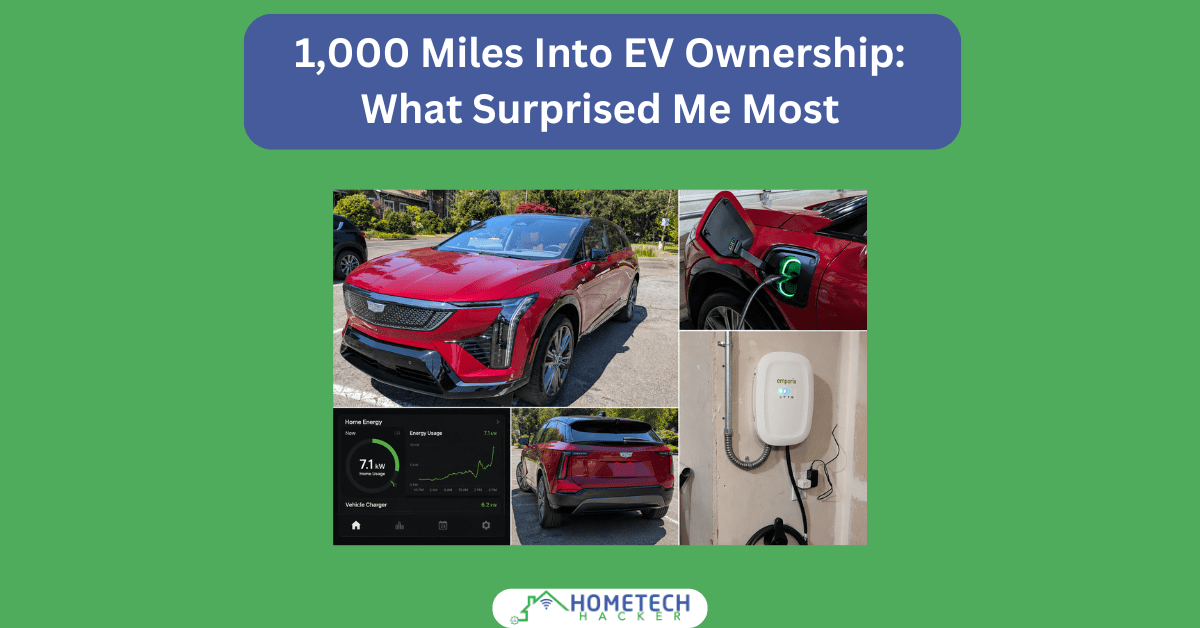
I purchased my first electric vehicle, a Cadillac Optiq AWD with an advertised range of about 310 miles. By the time you’re reading this, I’ll have driven roughly 1,000 miles and taken a couple of road trips. While that’s not enough time to become an EV expert, it’s certainly enough to form some first impressions.
The biggest surprise?
For my lifestyle, EV ownership has been remarkably easy.
This page contains affiliate links. If you purchase an item using an affiliate link I will receive a small commission at no cost to you. Affiliates do not influence my recommendations. Read my disclosures for more information.
Why I Finally Made the Switch
My daily driving profile is probably close to ideal for an electric vehicle.
I work from home a couple of days a week, and when I commute, it isn’t very far. Most of my driving consists of errands, family activities, and occasional trips around the Seattle area. I also have a garage and the ability to install home charging.
Those factors significantly change the EV ownership experience.
If you’re driving hundreds of miles every day, your experience may be different. For someone with a short-to-moderate commute and access to home charging, however, the transition from gasoline has been almost seamless.
Charging at Home Changes Everything
If there’s one thing I’ve learned during my first month of ownership, it’s this:
Home charging is the game changer.
Shortly after taking delivery of the car, I had a Level 2 charger installed in my garage. I chose the Emporia Classic charger and had it professionally installed alongside the electrical infrastructure necessary to support it safely.
Now I simply plug the vehicle in when I get home and wake up with a charged vehicle the next morning.
Editor’s note: I also have a standby generator, as detailed in my article about handling outages, that complicates installing a charger (technically, an EVSE). If you’d like to know more about it, get in touch with me in the comments or send me an email.
There’s no special routine. There’s no weekly trip to a gas station.There’s no standing around waiting for fuel. The vehicle spends most nights in the garage anyway, so charging simply happens while I’m sleeping. That convenience is difficult to appreciate until you’ve experienced it.
As someone who enjoys monitoring and understanding my home’s technology systems, I also found it interesting to watch charging activity appear on my Home Assistant energy dashboard. In fact, the charger was easy to spot immediately because of the significant increase in power usage while the vehicle was charging. If you’ve read my article on tracking home power usage and costs with Home Assistant, you’ll understand why that was particularly satisfying.
Even if you don’t have a Home Assistant power monitoring set up, you can see detailed power statistics in the Emporia app and in the MyCadillac app. EV life seems very tech forward so far, which I’ll touch on more later.
The Acceleration Is Better Than I Expected
Everyone talks about EV acceleration. It’s not hype.
My previous vehicles weren’t slow, but there is something uniquely satisfying about having immediate access to power at any speed. With a traditional transmission, there are moments when the vehicle seems to be in the wrong gear. Occasionally, it delays when shifting to a lower gear. Sometimes you feel gear changes. Sometimes the transmission makes decisions you wouldn’t have made yourself.
An EV simply goes. The power delivery is smooth, predictable, and immediate. After a month of driving, it’s the feature I appreciate most.

One-Pedal Driving Takes Some Getting Used To
One feature you’ll hear EV owners talk about frequently is one-pedal driving.
In traditional vehicles, lifting your foot off the accelerator causes the vehicle to coast. In many EVs, lifting your foot activates regenerative braking, slowing the vehicle while recovering some energy back into the battery. You can perform much of your everyday driving using only the accelerator pedal, rarely touching the brake.
I gave it a try. Some drivers love it and become devoted converts. Once you learn to modulate the accelerator carefully, it can feel smooth and efficient. Personally, I haven’t had the patience to adapted to it, yet.
Fortunately, the Cadillac Optiq allows one-pedal driving to be disabled, which is the setting I ultimately chose. The vehicle still uses regenerative braking, but the driving experience feels more familiar to me.
This was a good reminder that EVs often provide more customization than traditional vehicles. If you don’t like a particular feature, there’s a decent chance you can adjust it to fit your preferences.
EVs Still Have a Traditional 12V Battery

One thing I didn’t fully appreciate before becoming an EV owner is that EVs still have a traditional low-voltage battery. In my Optiq’s case, that’s a 12V battery similar in concept to what you’d find in a gasoline-powered vehicle.
The big high-voltage battery gets all the attention, but the 12V system still powers many of the vehicle’s computers, accessories, locks, lighting, and startup systems. If that battery fails, you can still have problems even if the main traction battery is fully charged. It makes sense once you think about it, but it wasn’t something I had really considered before buying an EV.
Like many aspects of EV ownership, I discovered that some things are completely different while others are surprisingly familiar.
Everything About EVs Feels Tech Forward
As a technology enthusiast, this may be one of my favorite aspects of EV ownership. Electric vehicles feel less like traditional cars and more like technology platforms on wheels.
There are settings for:
- Charging schedules
- Maximum charge percentages
- Preferred charging locations
- Energy usage tracking
- Mobile app controls
- Route planning
My Optiq even came with charging adapters and equipment that make it easier to use different charging options. The car infotainment system uses Android Automotive and is more like using a smartphone than a traditional car infotainment system. It has a massive 33-inch curved LED display with 9K resolution that is highly configurable. You can install apps right out of the Google Play Store. Heck, I can watch YouTube, Amazon Prime, HBO Max, and other streaming services on the display in my car (when it is in park).
It’s obvious that software plays a much larger role in the ownership experience than it does with most traditional vehicles. If you enjoy technology, that’s a good thing.
I Was Surprised by How Many Free Chargers Exist

Before owning an EV, I assumed most charging would either happen at home or require payment. And that is mostly true. What I didn’t expect was how many free charging opportunities exist.
I’ve encountered free chargers at:
- Shopping centers
- Public facilities
- Parking garages
- Community locations
- Workplaces
- Medical facilities
- Hotels
Some are slower than others, but they can still provide useful energy while you’re already parked. Free charging isn’t a reason to buy an EV, but it was a pleasant surprise.
The Charging Ecosystem Is More Complicated Than It Should Be
Not everything has been perfect about charging.The biggest learning curve has been public charging. Gas stations are simple.You pull up, swipe a card, and fuel.
Public charging is getting better, but it’s still more fragmented than I’d like. Different charging networks often require:
- Different apps
- Different accounts
- Different payment systems
- Different activation methods
In some cases, even free chargers require an app. I learned this the hard way.
One day I plugged into a charger, saw the indicator light turn green, and walked away, assuming everything was working correctly. When I returned later, I discovered the vehicle hadn’t charged at all because I hadn’t activated the charger through the app. Lesson learned.
Fortunately, things are improving. Tap-to-pay is becoming more common. Plug and Charge technology is expanding. Several apps can now help manage multiple charging networks. But compared to fueling a gasoline vehicle, there’s still more complexity than necessary.
Public Charging Is More Expensive Than I Expected
Another surprise was cost. Many people assume charging is dramatically cheaper than gasoline in every situation.That hasn’t been my experience.
Home charging generally offers significant savings. Public non-free charging often doesn’t. Depending on the location and charging network, costs can be higher than I expected and reduce much of the financial advantage. Also, rates vary by location, time of day, network, type of charging, etc.
For me, the economics work because I primarily charge at home. If I relied heavily on public fast charging, the savings would be much smaller, or possibly non-existent, depending on gas prices.
Road Trips Require Planning, Not Panic

A lot of people don’t by an EV because of range anxiety. After taking a couple of trips, I’ve concluded that planning anxiety is a more accurate term. The vehicle itself hasn’t been the problem. The challenge is making sure you know where you’ll charge if needed.
Fortunately, tools like PlugShare make this much easier.
Before a longer trip, I can quickly:
- Locate chargers
- Read reviews
- Verify availability
- Identify backup options
Navigation apps like Google Maps and Waze will even estimate when you need to charge and show you locations to charge on your road trip. A few minutes of planning eliminates most of the uncertainty.
Yes, road trips require more thought than a gasoline vehicle. No, they haven’t been nearly as difficult as I’ve heard many people fear.
What I’d Tell Someone Considering Their First EV
After 1,000 miles, my advice is fairly simple. If possible:
- Install home charging.
- Learn how public charging works before you need it.
- Download PlugShare.
- Understand your real driving habits.
- Don’t obsess over edge cases.
Most people spend far more time thinking about hypothetical road trips than they do considering their actual day-to-day driving patterns. For many households, daily driving is exactly where EVs shine.
Would I Do It Again?
Absolutely. For my lifestyle, switching to an electric vehicle has been easier than expected and more enjoyable than expected.
The driving experience is excellent. Charging at home is incredibly convenient. The technology is impressive. That doesn’t mean EVs are the perfect solution for everyone.
If you frequently drive long distances, can’t charge at home, or live in an area with limited charging infrastructure, your experience may differ. But for someone with a moderate commute, access to home charging, and a willingness to learn a few new tools, the transition from gasoline to electric has been surprisingly straightforward.
In fact, after just 1,000 miles, the thing that surprises me most isn’t how different EV ownership feels. It’s how normal it already feels.
Are you considering an EV? What’s holding you back? Let me know in the comments or on Twitter/X.
Interested in supporting HomeTechHacker?
Have you found the content on this site useful? If so, are you interested in supporting me and this site? There’s no obligation of course, but I would really appreciate any support you can give. Below are a few ways you can show support:
Thank you! I really appreciate it!
1000-miles-into-ev-ownership-what-surprised-me-most